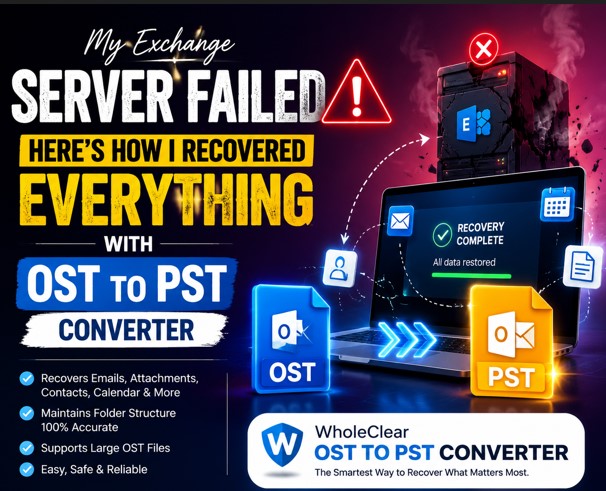
My Exchange Server Failed — Here’s How I Recovered Everything with OST to PST Converter
-

- June 13th, 2026
- 198 views

FREE SEO Topical Map Generator: Find Your Next Content Ideas
Some workdays are unforgettable and for me, it was the morning our Exchange Server just stopped working. I can recall opening Outlook and expecting to see my typical barrage of client emails, only to be met with an error message that initially didn't make much sense. IT quickly verified that our Exchange server had crashed overnight, which I was hoping wasn't the case.
I was unaware of its gravity at the time. However, I began to realize the true damage after repeatedly trying to reopen Outlook. That mailbox held years' worth of emails, project files, invoices and client communication threads. All of a sudden, nothing was reachable.
When I Discovered the True Issue
Outlook has been my go-to tool for business communications for the past seven or eight years. My OST file alone was almost 15.8 GB and included everything from ongoing customer contracts to early-stage business negotiations.
My initial thought upon the server's failure was straightforward: IT would restore it from backup. However, at noon, they told me that certain recent data would not even be accessible and that the backup restoration would take some time.
Panic really began at that point.
It involved more than simply emails. It was:
- Contracts with clients shared over lengthy threads
- Invoices and payment confirmations
- Project approvals
- Communication within HR
- Negotiations with vendors
My work was already being impacted by even a brief loss of access.
Methods That I Tried
Like most people, I went through every website and tutorials to solve this problem.
1. Rebuilding the Outlook profile
In the hopes that the mailbox will re-sync, I deleted and regenerated my Outlook profile. However, the OST file remained locked and ineffective in the absence of the server connection.
2. Checking PST Backup Files
I looked through my system's old backups. I discovered several PST files, but they were out of date and lacked important information from almost two years ago.
3. Manual Export
I even attempted to export data from Outlook in offline mode. However, Outlook was unable to verify the server connection, so it simply failed to load the mailbox correctly.
It was at this time that I noticed something crucial: the OST file was still there, but without Exchange, it was totally useless.
I started looking for a solution specifically for "OST file recovery after Exchange crash" at that point.
Found a Reasonable Solution
One common recommendation that I noticed when reading forums and talking with a coworker was to convert OST to PST so that the data could once again be accessed.
At that point, I discovered a program named WholeClear OST toPST Converter. I only wanted something that could securely get my inbox info, nothing more.
I made the decision to test the trial version before making a purchase.
Experience with the Trial Version
I was able to scan and preview my OST file with the trial version. In fact, that was the most comforting aspect.
Upon loading my 15.8 GB file:
- Every folder showed up correctly.
- The emails were undamaged.
- The attachments were visible.
- Additionally, calendar entries were listed.
However, as was to be expected, the trial edition only permitted preview and restricted conversion (a small piece of data).
However, the structure appeared flawless, which provided me sufficient assurance to move forward.
Experience with the Conversion Process
It was very easy to install the complete version.
- From my system, I choose the OST file.
- The program took many minutes to scan the file.
- The entire mailbox structure was shown.
- I chose PST as the export format.
- Initiated the conversion procedure
My huge file took about 30 to 40 minutes to convert. Surprisingly, everything went through without a hitch. I was expecting mistakes or missing data.
After that, I imported the PST file into Outlook, and my entire inbox returned to its previous state.
To be honest, it was a relief to see old emails, conversations and attachments again.
What Was Effective (Pros)
Here's what caught my attention after using it extensively:
- No technical complexity and an easy-to-use interface
- Properly maintained the folder structure
- Emails, attachments and metadata were kept safe.
- Managed big OST files without experiencing crashes
- The preview function was really beneficial prior to conversion.
- In my case, no data corruption was observed.
What Wasn't Effective (Cons)
Since nothing is flawless, this software also had certain drawbacks:
- Processing large files takes time.
- The trial version is extremely constrained.
- There are no sophisticated filtering choices for selective recovery
- Installation is necessary (no portable version)
- A little lag while scanning really large mailboxes
Although not a deal-breaker, these were noteworthy.
My Own Evaluation
In light of my experience:
- Usability: 4.8 out of 5
- Performance: 4.5 out of 5
- Data accuracy: 4.7 out of 5
- Speed: 4.3 out of 5
- Overall rating: 4.6 out of 5
Concluding Remarks
It's like losing a piece of your career when you can't access an Exchange mailbox. In my situation, I had to cope with lost business continuity in addition to missing communications.
This incident taught me a straightforward lesson: OST files are unreliable when used as a stand-alone backup. They rely entirely on Exchange and access is impossible if it malfunctions.
Without requiring server recovery or IT-level assistance, I was able to restore access to years' worth of crucial correspondence by using WholeClear OST to PST Converter.
It was like regaining control over something I believed to be irreversibly lost, but it didn't feel like magic.
My experience might be summed up in one sentence as follows:
I was able to get my work history in addition to emails.